
Every parent dreams of giving their child a name that carries both beauty and eternal meaning a name that whispers hope through life’s storms.
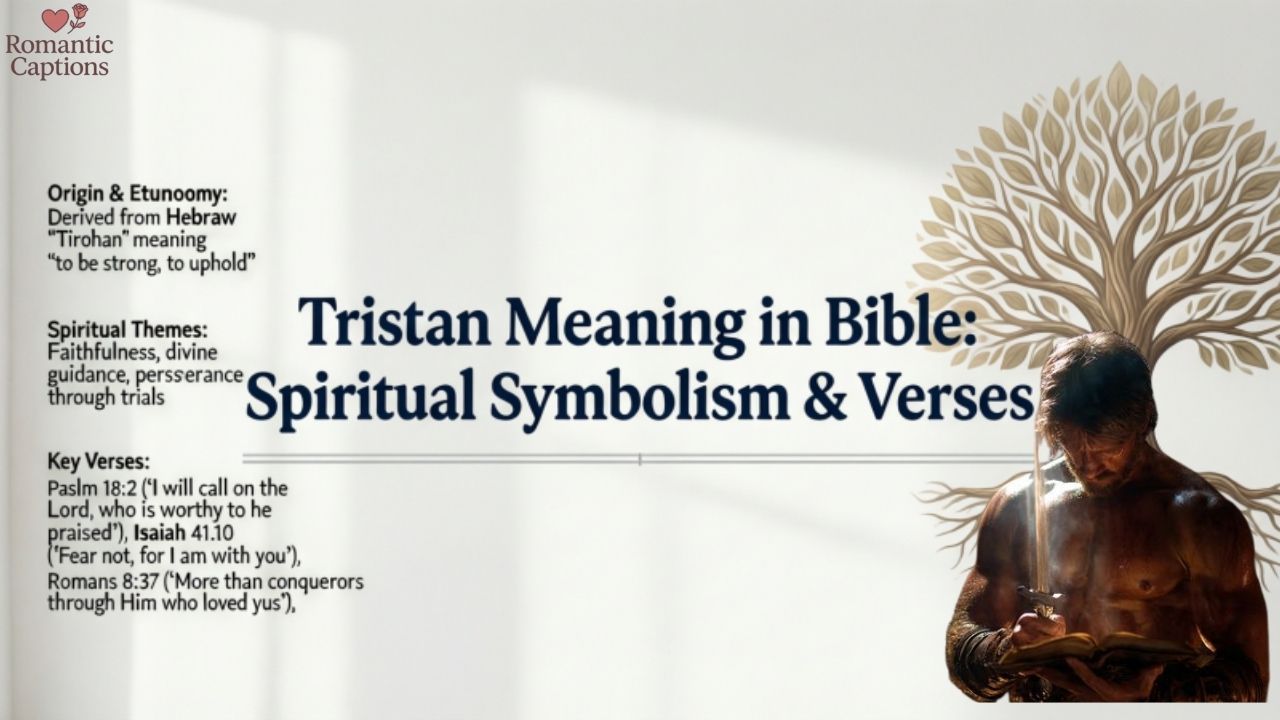
The Tristan meaning in Bible contexts reveals profound spiritual weight, connecting deeply with biblical themes of redemptive suffering, divine transformation, and covenant faithfulness. Understanding the Tristan meaning in Bible principles shows how it embodies Christian values found in Job’s perseverance, Joseph’s redemption, and Paul’s sanctified suffering.
This exploration reveals how Tristan connects to Scripture passages and spiritual principles that define faith. Understanding this name unlocks deeper appreciation for how God transforms sorrow into joy and fulfills His divine purpose through life’s challenging seasons.
👉Explore powerful pornography prayer points with scriptures
Table of Contents
Is the Name Tristan Found in the Bible?
The straightforward answer is no Tristan does not appear anywhere in Scripture, from Genesis through Revelation.
You won’t discover this name among the prophets, apostles, patriarchs, or any biblical figure. No Old Testament hero carried this name into battle. No New Testament disciple signed letters bearing this identity. The Hebrew Bible contains no record of Tristan, nor do the Greek manuscripts reference it.
This creates confusion for parents seeking names with biblical roots. They search concordances, study Bible dictionaries, and examine every genealogy hoping to find scriptural validation. When their search yields nothing, many conclude the name lacks spiritual legitimacy.
Consider these compelling examples:
- Christopher means “Christ-bearer” a deeply Christian concept yet never appears in biblical text
- Trinity describes core Christian doctrine but isn’t found in Scripture as a name
- Grace, despite being central to salvation theology, doesn’t appear as a personal name in God’s Word
The spiritual meaning of any name emerges not solely from biblical appearance but from thematic resonance with scriptural truth. It’s about what the name represents within a Christian worldview, how it reflects biblical principles, and whether it aligns with kingdom values.
The Real Origin of Tristan Celtic Roots Meet Christian Europe
Understanding where Tristan comes from requires examining linguistic history, cultural migration, and the spread of Christianity across Europe.
The Latin Connection
The most widely accepted etymology traces Tristan to the Latin word “tristis,” meaning sorrowful or sad. As the Roman Empire expanded, Latin terminology spread throughout Europe, eventually encountering emerging Christian communities.
Early believers didn’t shy away from names acknowledging life’s difficulties. They understood that biblical faith embraced the full spectrum of human experience, including grief, hardship, and suffering. The Christian worldview never promoted toxic positivity it recognized that sorrow often serves as God’s pathway to transformation.
The Celtic Alternative
Another scholarly theory connects Tristan to Celtic origins, specifically the Welsh names Drustan or Trystan. These meant “tumult,” “riot,” or “noise” terms that might seem negative but carried nuanced meaning in Celtic culture.
Celtic Christianity maintained distinctive characteristics while embracing biblical orthodoxy. In this tradition, “tumult” didn’t necessarily indicate chaos or disorder. Instead, it suggested:
- Spiritual warfare against demonic forces
- The disruption of evil and darkness
- The warrior spirit required to advance God’s kingdom
- Strength to disturb enemy strongholds
Medieval Synthesis
By the Middle Ages, these streams merged into a unified understanding. The Tristan and Isolde legend popularized the name across Christian Europe, embedding it firmly in Western culture despite the story’s problematic elements.
| Origin | Literal Meaning | Spiritual Interpretation | Cultural Context |
| Latin (tristis) | Sorrowful, sad | Redemptive suffering, sanctified grief | Roman Christian expansion |
| Celtic (Drustan/Trystan) | Tumult, riot, noise | Spiritual warfare, divine disruption | Welsh Christian tradition |
| Medieval synthesis | Sorrow transformed by faith | Suffering producing perseverance | European Christendom |
Biblical Themes That Mirror Tristan’s Meaning

The Bible overflows with narratives demonstrating how God transforms difficulty into blessing, pain into purpose, and sorrow into strength. These scriptural patterns give profound depth to names associated with hardship.
Sorrow as Sacred Pathway
Job represents Scripture’s ultimate example of sanctified suffering. He lost children, wealth, health, and reputation in rapid succession. Yet through it all, Job maintained faith, declaring:
“Though he slay me, yet will I hope in him” (Job 13:15)
The Book of Job demonstrates that righteous suffering exists. Not all hardship results from personal sin. Sometimes God permits trials for purposes beyond immediate understanding, to refine character, deepen faith, or demonstrate His glory.
Paul wrote extensively about redemptive hardship:
“I consider that our present sufferings are not worth comparing with the glory that will be revealed in us” (Romans 8:18)
Jesus himself blessed those who mourn: “Blessed are those who mourn, for they will be comforted” (Matthew 5:4). Grief in Scripture isn’t the final word it’s the pathway to divine comfort, spiritual depth, and eternal joy.
Tumult and Divine Purpose
Jacob wrestled all night with God, an encounter that left him physically limping but spiritually blessed. God renamed him Israel “one who struggles with God.” That tumult became the foundation of an entire nation (Genesis 32:24-30).
Jonah experienced literal tumult a violent storm sent by God because of disobedience. The chaos on that ship led to:
- His repentance inside the great fish
- Obedient preaching to Nineveh
- The salvation of 120,000 people
- God’s mercy demonstrated to nations
From Grief to Glory
Joseph’s betrayal by his brothers produced years of slavery and wrongful imprisonment. Yet he ultimately told those same brothers:
“You intended to harm me, but God intended it for good to accomplish what is now being done, the saving of many lives” (Genesis 50:20)
King David wrote Psalm 30:5: “Weeping may stay for the night, but rejoicing comes in the morning.” Later in that same psalm: “You turned my wailing into dancing; you removed my sackcloth and clothed me with joy“ (Psalm 30:11).
Ruth lost her husband in a foreign land, returning to Israel as a childless widow—the lowest social status imaginable. Yet her story concludes with marriage to Boaz, provision for her family, and inclusion in Christ’s lineage. Matthew 1:5 lists her among Jesus’ ancestors.
Five Spiritual Symbols Embedded in Tristan’s Identity
Suffering as Sanctification
Romans 5:3-5 provides the theological framework:
“Not only so, but we also glory in our sufferings, because we know that suffering produces perseverance; perseverance, character; and character, hope.”
Notice the progression: suffering → perseverance → character → hope
Naming a child Tristan acknowledges this biblical pattern. You’re not cursing them with permanent sadness. Instead, you’re declaring that when trials come—and Scripture promises they will—God uses them for sanctification and spiritual growth.
Redemptive Narrative Arc
Every biblical hero faces darkness before dawn:
- Moses spent 40 years as a fugitive before leading Israel
- David hid in caves while Saul hunted him
- Peter denied Christ three times before becoming the rock of the church
This pattern repeats: struggle → redemption → purpose
A child named Tristan inherits this narrative framework. Their name symbolism points toward God’s plan to use suffering for transformation.
Warrior Perseverance
Ephesians 6:10-18 describes the armor of God, with every piece protecting against spiritual attack. Christianity isn’t passive—it’s a militant faith engaged in spiritual warfare.
Joshua received this command repeatedly: “Be strong and courageous. Do not be afraid; do not be discouraged, for the Lord your God will be with you wherever you go” (Joshua 1:9)
Covenantal Faithfulness Over Emotion
First Corinthians 13 defines love not as feeling but as action: patient, kind, not self-seeking. It’s covenant love that honors promises despite emotional fluctuation.
Hosea’s faithful love for his unfaithful wife Gomer mirrors God’s relationship with Israel. That’s sacrificial love—choosing covenant commitment over emotional satisfaction.
Beauty From Ashes Restoration
Isaiah 61:3 prophesies that God will “provide for those who grieve in Zion to bestow on them a crown of beauty instead of ashes, the oil of joy instead of mourning, and a garment of praise instead of a spirit of despair.”
Jesus Christ read this passage in the synagogue at Nazareth, declaring its fulfillment in Himself (Luke 4:18-21).
Tristan as a Christian Name The Verdict

What Makes Any Name “Christian”?
Names don’t appear in heaven stamped “approved” or “rejected” by divine decree. Biblical figures bore names common to their cultures, reflecting linguistic patterns of their time and place.
Ruth wasn’t Hebrew originally she was Moabite, from a nation often hostile to Israel. Yet she’s celebrated in Scripture, included in Christ’s genealogy, held up as a model of faith and covenant loyalty.
Historical Precedent
Church history overflows with saints bearing non-biblical names:
- Benedict (meaning “blessed” but never in Scripture)
- Cecilia (from a Roman family name)
- Patrick (from Latin meaning “nobleman”)
- Augustine (derives from Augustus, a pagan emperor title)
Tristan entered Christian usage centuries ago. Medieval European Christians baptized thousands of boys with this name.
Intention Matters Most
Naming theology emphasizes parental heart and teaching approach over pure linguistic origin.
If you choose Tristan to honor the medieval legend’s adultery, that’s problematic. If you choose it to remind your child that God works through suffering that’s deeply biblical.
David means “beloved” a beautiful meaning. Yet King David committed adultery and murder. The name didn’t dictate behavior faith and choices did.
Practical Considerations
Before finalizing any name, wise parents consider:
- Pronunciation in your cultural context
- Potential nicknames (Tris, Stan)
- How it pairs with siblings’ names
- Whether it honors family heritage
- If it creates testimony opportunities
Better Than Many “Biblical” Names
Some directly biblical names carry deeply problematic associations:
- Jezebel represents wickedness and idolatry
- Judas has insurmountable betrayal associations
- Cain murdered his brother
- Athaliah slaughtered her grandchildren
Meanwhile, Tristan absent from Bible pages aligns with core biblical themes: transformation through suffering, perseverance in trials, and divine purpose working through difficulty.
Separating Medieval Legend from Biblical Truth
The Legend’s Basic Plot
The medieval legend tells of a knight who falls desperately in love with his uncle’s bride. A love potion causes the forbidden attraction. They engage in an adulterous affair, leading to exile and tragic death.
Where the Legend Conflicts with Scripture
Key conflicts with biblical values:
- Adultery explicitly breaks the seventh commandment (Exodus 20:14)
- Emotional passion overrides marital commitment
- The story operates under fate, not divine purpose
- The ending emphasizes tragic despair without redemption
Redeeming Cultural Narratives
Christian parents can name their son Tristan while explicitly teaching the legend’s failures. Use it as a case study in covenant love versus emotional passion, biblical marriage versus cultural romance.
Paul did exactly this with Greek philosophers, quoting them while correcting their errors (Acts 17:22-31).
How to Frame the Name’s Legacy
When your child asks about their name:
“Your name means ‘sorrowful,’ but in our family, it means something beautiful and hopeful. It reminds us that God uses hard things to make us strong, that suffering produces perseverance. Like Job, like Ruth, like Joseph everyone in the Bible who faced pain and found God’s redemptive plan in it.”
Bible Verses Perfect for a Child Named Tristan

Jeremiah 29:11
“For I know the plans I have for you, declares the Lord, plans to prosper you and not to harm you, plans to give you hope and a future.”
Application: Your name acknowledges life’s difficulties, but this verse promises that God’s good plan ultimately prevails.
Psalm 147:3
“He heals the brokenhearted and binds up their wounds.”
Application: God specializes in healing heartbreak—He sees your sorrow and brings divine comfort.
2 Corinthians 4:17
“For our light and momentary troubles are achieving for us an eternal glory that far outweighs them all.”
Application: Any suffering you face is temporary; the glory coming in Christ is eternal.
Romans 8:28
“And we know that in all things God works for the good of those who love him, who have been called according to his purpose.”
Application: God uses everything—even pain and hardship—for ultimate good in your life.
Isaiah 43:2
“When you pass through the waters, I will be with you; and when you pass through the rivers, they will not sweep over you.”
Application: You’ll face trials, but God promises His faithful presence through them all.
James 1:12
“Blessed is the one who perseveres under trial because, having stood the test, that person will receive the crown of life.”
Application: Your perseverance through hardship earns eternal reward.
Matthew 17:20
“Truly I tell you, if you have faith as small as a mustard seed, you can say to this mountain, ‘Move from here to there,’ and it will move.”
Application: Even small faith overcomes impossible circumstances.
Tristan Meaning in Bible Hebrew
The name Tristan has no Hebrew equivalent in biblical Hebrew language. This shouldn’t surprise anyone—Tristan originates from Latin or Celtic roots, not Semitic languages.
Hebrew words capturing related concepts include:
- ‘Atzav (עצב) – sorrow, grief, pain
- Yagon (יגון) – grief, mourning
- Tzarah (צרה) – trouble, distress, tribulation
These terms appear in Psalms, Lamentations, and Job, always within contexts of divine comfort following human suffering.
Tristan Meaning in Bible Catholic

Catholic tradition embraces Tristan as a legitimate Christian name despite its absence from Scripture, viewing it through church history and theological development.
The Catholic Church recognizes that not all Christian names must appear in Bible text. Saints throughout church history bore names of various origins—all sanctified through faithful Christian living.
Several factors make Tristan acceptable:
- Medieval Christian usage throughout Catholic Europe
- Absence of pagan deity associations
- Alignment with Christian virtues of suffering and perseverance
- Connection to saints who endured suffering for faith
Tristan Meaning in Greek
The name Tristan has no direct Greek origin, though Greek philosophical and theological concepts illuminate its spiritual significance.
New Testament Greek distinguishes between types of sorrow:
- Penthos (πένθος) – grief, mourning
- Lupe (λύπη) – pain, sorrow, distress
Second Corinthians 7:10 makes this critical distinction: “Godly sorrow brings repentance that leads to salvation and leaves no regret, but worldly sorrow brings death.”
Tristan Meaning in Arabic
Arabic words capturing related concepts include:
- Huzn (حزن) – sadness, grief
- Alam (ألم) – pain, suffering
- Dheeq (ضيق) – distress, tribulation
Arabic Christian communities have developed rich theological vocabulary describing redemptive suffering through centuries of persecution and martyrdom.
Is the Name Tristan in the Bible
This question deserves direct answer: No, the name Tristan does not appear anywhere in Scripture.
Comprehensive Bible concordances contain zero entries for Tristan. Computer searches of original language texts yield no results.
This fact doesn’t diminish the name’s Christian legitimacy or spiritual value.
What Does Tristan Mean in Latin
In Latin, Tristan derives from “tristis,” meaning sad, sorrowful, or melancholic.
As Christianity spread throughout the Roman Empire, Latin became the Church’s liturgical language. Early Christian communities adopted Latin terminology, infusing pagan linguistic roots with biblical meaning.
The Latin “tristis” took on new dimensions:
- Redemptive sorrow – Pain leading to repentance
- Sanctified grief – Mourning transformed by divine comfort
- Purposeful suffering – Hardship used for sanctification
Tristan Mythology
The Tristan and Isolde legend represents the primary mythological association. Key mythological elements include the love potion, forbidden romance, tragic fate, and ending without redemption.
Christian families using Tristan should understand this background while explicitly rejecting its anti-biblical elements. The name can be reclaimed when separated from legendary associations and connected to scriptural truth.
Conclusion
The name Tristan stands as a powerful testament to Christian faith despite its absence from Scripture. Through centuries of church history, believers have sanctified this name, connecting it to profound biblical themes of redemptive suffering, divine transformation, and covenant faithfulness.
Parents choosing Tristan make a bold declaration about God’s sovereignty over life’s difficulties. They acknowledge that suffering produces perseverance, that hardship builds character, and that divine purpose works through every circumstance.
Ultimately, Tristan embodies the essence of Christian existence living between resurrection and restoration, trusting that God works all things for good, and believing that eternal glory far outweighs temporary suffering. It prepares children for faithful lives that honor God through every season.
FAQ’s
What does the name Tristan mean in the Bible?
Tristan is not a biblical name it has Celtic roots often linked with sorrowful or tumultuous meaning.
What is the meaning of Tristan?
Tristan generally means full of sorrow or sadness, derived from old Celtic and medieval legends and tales.
Is the name Tristan good?
The name Tristan is considered good, strong, and romantic, appreciated for its classic, timeless charm and appeal.
What does Tristan symbolize?
Tristan symbolizes love, loyalty, and tragedy, inspired by the famous medieval romance story of Tristan and legend.
What does Tristan represent?
Tristan represents passion, bravery, and deep emotion, often associated with legendary romantic hero qualities and noble ideals.
Which Bible name means gift from God?
The Bible name Matthew means gift from God, and Theodore carries a similar beautiful meaning as well.

Ember Soul is a romantic writer with over 10 years of experience in creating heartfelt captions and love quotes. She beautifully expresses emotions of love, passion, and connection through her words, turning simple feelings into meaningful expressions that touch the heart. 💖